
Rediscovering curiosity and compassion
Fresh from working on The Roots ‘Experience’ strand of exchanges, we’ve noticed just how many books are being published around the subjects of human connection and cognitive diversity at the moment. In light of the unprecedented period we have all spent physically apart, it’s no surprise. None of the fundamental ideas are new to us either; Roots believe that our differences are not what necessarily divide us but that the fewer and fewer opportunities we have to interact with those who are different to ourselves certainly does. We developed a series of activities to bring adults with very different lives, from different locations, across regional, national and community roles, together in a neutral space to talk, share, build a connection, understanding and find compassion for their partner.
To allow participants to come together in an equitable partnership, we moved slowly with activities, introducing location, voice, tastes and the issues that individuals were passionate about along with tales of the people who had acted to connect and help them in their journey. We hoped to support two humans to make contact, meeting on an equal platform, to be curious about one another’s lives, share memories and passions.
Back to those books we’ve been reading, ‘Rebel Ideas: The Power of Diverse Thinking’ by Matthew Syed, ‘Fractured’ by Jon Yates and ‘Messy’ by Tim Harford are but a few. All discuss, present and demonstrate the need for cognitive diversity in our workplaces and organisations to create complex, better systems that work best for most and to turbo-power creativity when we are exploring new ideas. They talk about the need for a plethora of different kinds of thinking to approach a problem, which brings to mind the work of Temple Grandin, a prominent author and scientist who has often spoken on the untapped potential of people with autism in the workplace. This was not to repeat the slur that people with autism all have some kind of hidden superpower, she wished to establish the idea that complex problems take ‘all kinds of minds’ to solve them, that neurodiversity is normal and vital, rather than any kind of deficit.
Teams of cognitively diverse individuals do better, it’s been studied and can be well-supported across a number of instances, from those chosen to work at Bletchley Park to an averaging of thousands of guesses in an early 20thC game of ‘guess the weight of the Ox’. This all works well if we are to assume that those in our highly paid, highly educated engineering department genuinely consider those with plenty of experience but a lower wage on the manufacturing floor to be their equals. We all know we should consider our fellow man to be our equal without having them prove or justify it, but have a look around, we don’t.
A friend, who I am fairly sure regularly votes in the opposite direction to myself, gave me a very old copy of Thomas Paine’s ‘Rights of Man’ as a gift. The unexpected gift giver just made me promise to read it. I read it and stuck a sticky note on the page where he wrote “Whatever is my right as a man is also the right of another; and it becomes my duty to guarantee as well as to possess.” Whilst elbow deep in my stack of books, that all excited me with their foundational idea that the best could only possibly come from a group plucked indiscriminately from the 66.65million corners of our society, I watched an online lecture from Anne Phillips, the Graham Wallas Professor of Political Science at the London School of Economics. She is publishing her book ‘Unconditional Equals’ later this year, and what she spoke about seemed to blow cool air on the excitement of my earlier cognitive diversity odyssey. She said that human equality is a commitment we should make to one another, not just something we maintain by blindly ignoring our differences. I hadn’t thought of this…it provoked a relationship audit, a worldview audit, and a big judgement audit all riddled with guilt and, hopefully, awakening. I thought about my neighbourhood, the woman sat on her step all day smoking, the man sitting at the war memorial drinking tins of beer all day. I subconsciously place conditions in terms of who is equal to me, but these people are my equals, they are. I needed that audit and rediscovery of some basic humility.
In my humblest of opinions, the most beautiful upshot from meeting people living a very different life to our own, for brave and in-depth conversation around those differences, is often not a watershed moment where we change position dramatically on a single issue but the ongoing moments when we realise that everything we already know is knitting together with the new knowledge to create a broader, clearer vision of the world around us. We are already on the right track, we just need to commit to seeing the other lives as something intertwined through our own and just as important.
“I have always strenuously supported the right of every man to his own opinion, however different that opinion might be to mine. He who denies to another this right, makes a slave of himself to his present opinion, because he precludes himself the right of changing it.”
― Thomas Paine, The Age of Reason
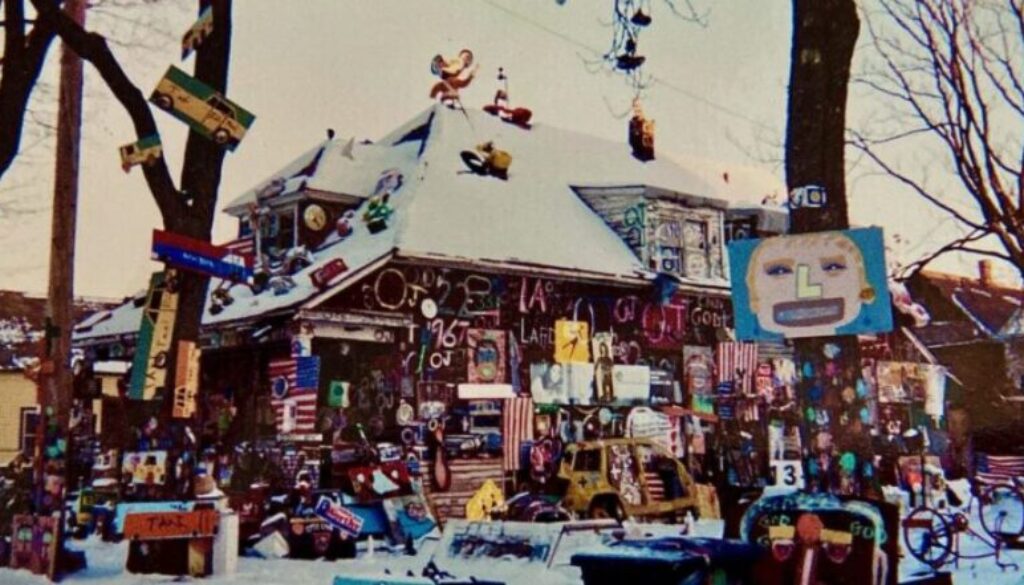
*Image: Tyree Guyton’s ‘Heidelberg Project’, Detroit (Photo: ‘Diverse Thinker’ by Clare Richardson, 2001)


