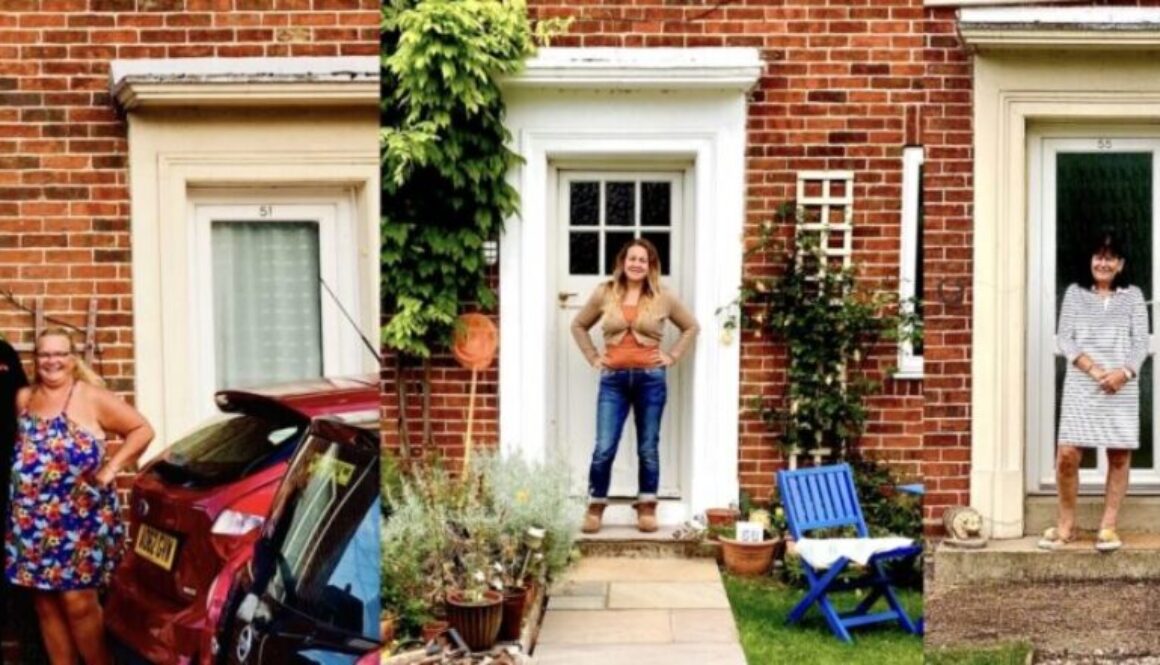
Neighbouring, Listening and Belonging
I’ve lived here on this long road for twelve years, although I only really formed warmer relationships with my neighbours since I became a single-parent five years ago. Even those were only maintained by some conversations over the fence, the odd lend of something, nothing profound, and I often thought, at night and in the early months of being partner-less, that if anyone tried to break into my house, I didn’t even have the phone numbers to call for help next door.
My left-hand neighbour and I share a passageway, as well as the experience of single parenthood. She has five girls, almost all of whom have now left home. She is funny, practical, sage and is the well of so much love from and to her family that she could sink a ship with it. My right-hand neighbour has five boys, a few of whom are still at home with her and her husband, and a few years ago she became a member of lunchtime staff at my son’s school. We didn’t find many points at which to chat much, but she’d often walk around my house and visit my other neighbour.
During Lockdown we inadvertently sky-watched for Starlink together, all three households sat in our respective front gardens with a glass of something, chatting and laughing more than looking upwards. Last Autumn we all spent an un-arranged afternoon taking a collapsed hedge out together and recently we all got together in the garden to watch the football final and then to communally discuss what to do with my car which constantly broke down. We now have a common life that I am proud of, not just borrowing cups of sugar, I care, they care, we all care about one another with quiet understanding.
Our front garden abuts the route of a lovely walk with views all over the valley and so we saw a huge amount of people from the community, repeatedly taking their walk, over the Summer last year. It made me think about the two ends of this street, one long stretch of road lined with houses but divided by its two names and, loosely, by style of housing and socio-economic background. The part my neighbours and I live in is an area of 1930’s social housing and, as you get further down towards town, the name of this road changes and some of the houses get quite a lot larger, older, and grander, although there are also a lot of small terraces too. One of them, far, far down the other end is a ‘hall’, gated with tall brick walls surrounding it, a grand portico thing, ornate gardens and a fleet of cars straight out of ‘Yes Minister’, all of which can be seen when the gates occasionally open to let a Jag in or out.
That difference in street name matters to many, I think, and it’s a shame we are divided by that symbolic fence. The sense of community we felt back last Summer has waned a little, people don’t do the Love Lane walk so often and we sit out the front far less. It led me to wonder how we could take advantage of the remnants of that upsurge in community enthusiasm, remarked upon up and down the country, and continue to get to know each other better, more deeply than a nod and a passing wave.
Years ago, I filmed reminiscence interviews with 60 elderly people around the district and witnessed the effect that being deeply listened to has on a human, it can bond us deeply within half an hour if we listen with compassion and interest. More recently, I was introduced to the 30’s and 40’s Mass Observation diaries by a nearby friend and fell in love with all the ordinary voices telling their ordinary, exquisitely descriptive stories of times gone by – previously unheard angles on lives we shall never know. I started reading Tony Parker’s moving oral history-based accounts of ordinary people in the 60’s, some more from the Studs Terkel archive and went on to buy a small, but not ordinary, recording device myself. I have made many recordings with people in my neighbourhood over the past month, experimenting with techniques spoken about by Tony Parker and Studs Terkel.


The recordings with my adjacent, immediate neighbours were especially lovely moments. The first was my neighbour with whom I share a passageway. It was an early experiment, I asked her some questions and just as soon as I pressed stop on the recorder, she began to talk freely, joyfully and memories of her childhood neighbourhood were flying out of her. When I recorded a later conversation with the neighbour the other side, I made extra sure she was comfortable with me and with the recorder, comfortable in her chair, I let the recording run, allowed some silence in and she spoke at length, gloriously colourfully and as though she was interviewed like this on a daily basis. Every person I interviewed was certain they would not have anything interesting to say, all were fascinating, and a few were moved to tears, not by the themes but, I think, through the process of being listened to so closely.
‘Where do you belong?’ was a question I have asked almost everyone, and it has been the hardest for people to consider and to verbalise. I don’t know where to begin with my own answer to it, but it gave people a chance to really think about place, identity, community, friends and, commonly, where they don’t belong anymore. It has led me to believe that belonging is, perhaps, a commitment we make to those around us that we decide to lead a common life with. I thought I wasn’t much like my neighbours but it turns out they think I am just like them and that I belong here and that’s bloody beautiful.
*With special thanks to Linda, and Eileen and Andrew (all pictured, along with Dave the spaniel), for supporting my research and generally humouring me and being very good neighbours.